Dog Microchip Guide: What You Need to Know Before Buying Fi Nano vs Manruta
Complete comparison of Fi Nano and Manruta microchips for dogs. Learn how microchips work, recovery statistics, implantation safety, registration importance, and step-by-step protection guide.
What You Need to Know Before Buying a Dog Microchip: Fi Nano vs Manruta
The Fear Every Dog Owner Has
I recently saw a desperate family at the clinic. Their dog, Max, a five-year-old Labrador, had disappeared during a park visit. They had been without him for 36 hours. What broke my heart was hearing the mother say: I never thought it would happen. I thought a collar was enough.
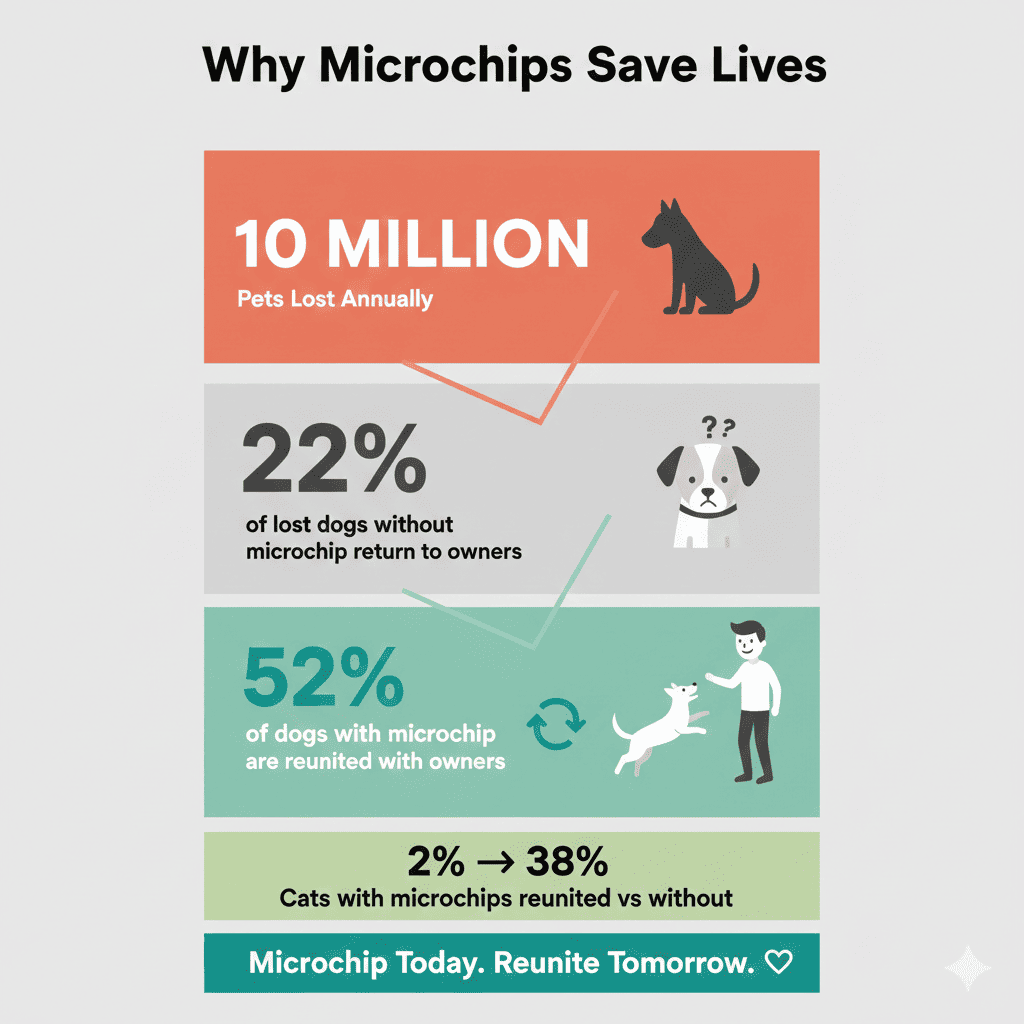
The reality is brutal. According to the American Veterinary Medical Association, over 10 million dogs and cats are lost or stolen each year in the United States. That's one in three animals that will disappear from home at some point in their lives.
But here's the statistic that will make you understand why I'm writing this: while only 22% of lost dogs without a microchip return to their owners, that percentage jumps to over 52% when the animal has electronic identification. For cats, it's even more dramatic: from 2% to 38%.
A microchip isn't a luxury. It's the difference between getting your best friend back and spending the rest of your life wondering what happened to him.
What You'll Learn Here
I'll show you exactly how microchips work, why Fi Nano and Manruta are the most popular options on Amazon, what real differences they have, and most importantly, how to implant them correctly to avoid complications. It's not just about the brand you choose—it's how you use it.
What Exactly Is a Dog Microchip?
Imagine a grain of rice. Now imagine that inside that grain is an identification device that will stay with your dog for his entire life.
A microchip is a radiofrequency identification (RFID) tag the size of a grain of rice. It contains a unique 15-digit number that's impossible to duplicate legitimately. When a veterinary scanner passes over your dog, it detects that number and links it to a database where your contact information is stored.
It's not GPS. This is the biggest confusion I see. The microchip does NOT track your dog in real time. It won't tell you where your dog is right now. What it does guarantee is that if your dog is found by someone and taken to a shelter or veterinary clinic, professionals can scan it, get your unique identification number, and locate you in the registration database.
Everything works thanks to an international standard called ISO 11784/11785. This standard defines the 134.2 kHz frequency and two main protocols: FDX-B (full duplex) and HDX (half duplex). Both products we are comparing today meet this standard, which means any modern veterinary scanner can read them without problems.
The trick is this: a scanner does not need to be connected to the internet. It does not need sophisticated mobile applications. It's just a radiofrequency device that reads the electronic information under your dog's skin. That's why it works in any shelter in the country, even in small towns without advanced technology.
Fi Nano Microchip: Complete Analysis
What Will Attract You
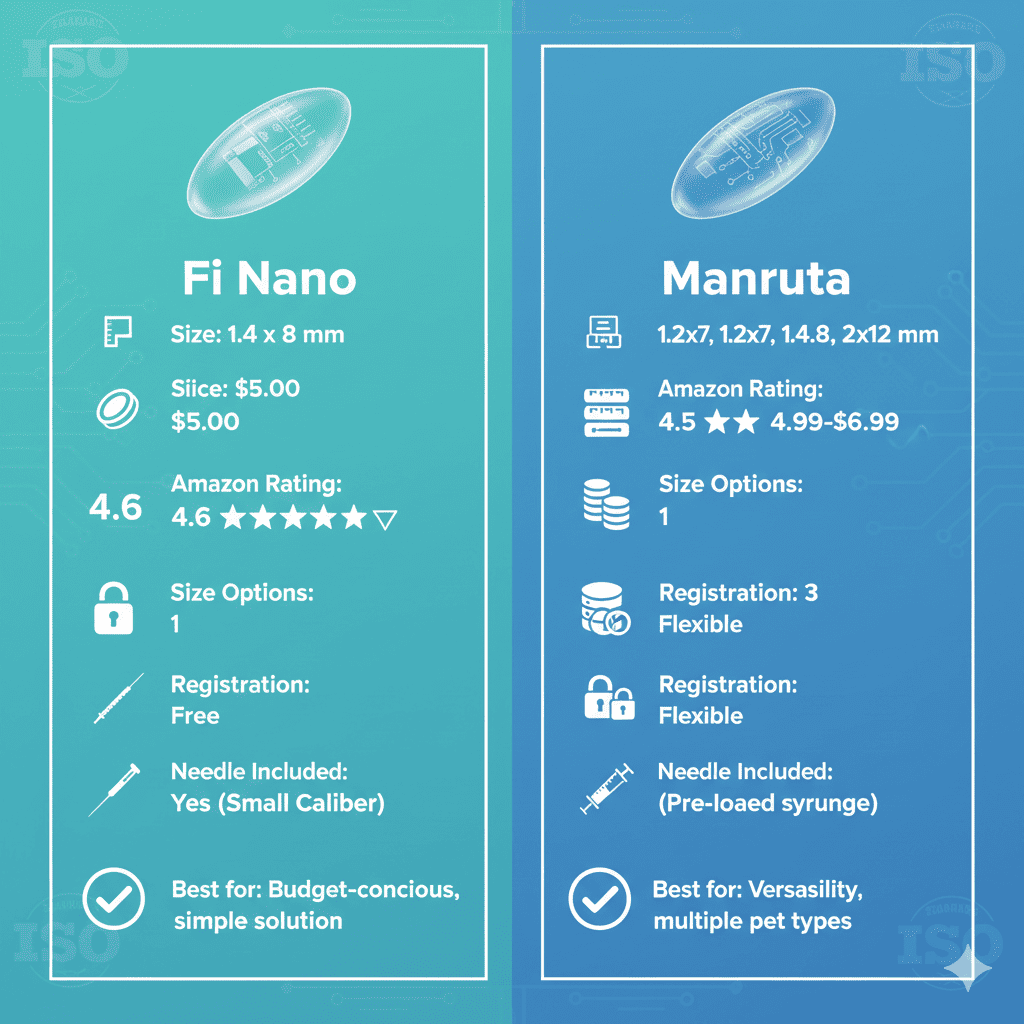
The Fi Nano is extremely small. It measures 1.4 millimeters in diameter and 7 millimeters in length. It's perfectly scalable for small breeds, puppies, and kittens. The included needle is small gauge, meaning the injection is less traumatic than other brands.
The price is $5.00, one of the most competitive on the market. But what really shines is its registration system: it's free for life at nano.tryfi.com. No annual fees. No surprises in the future. You can update your contact information from any smartphone or computer anytime.
Reviews are solid: 4.6 stars with 749 comments. Most users report ease of use, good readability in scanners, and most importantly, satisfaction because their pets were found and returned when they got lost.
The Honest Complications
Now, because I work in this every day, I must be honest: there's a serious problem reported in Fi Nano reviews.
A user named Zach left a 1-star review in August 2023 detailing that he received two Fi Nano microchips with duplicate identification numbers. They were not unique. In the microchip world, a duplicate number is a disaster. Imagine your dog gets lost, someone finds him, they scan him, but the number shows up registered under another owner in another city. What's the result? Administrative chaos and the real possibility that your dog won't be returned correctly.
Now, one negative review out of 749 isn't a trend. But it's enough to deserve attention. Zach did the right thing: he verified the number using a microchip registry lookup before implanting. Most owners don't do this.
The Critical Part: Implantation
The Fi Nano package clearly states: For implantation by a trained professional veterinarian only. This is where many owners go wrong.
I have seen YouTube videos of people injecting microchips into themselves and their pets without veterinary supervision. It's tempting to save the cost of a vet visit. But here's the real risk: incorrect implantation can cause chip migration, infection, bleeding, nerve damage, or in extreme cases, shock.
The veterinarian doesn't just insert the needle. He knows exactly where to place it (ideally between the shoulder blades, in the dorsal area), what angle to use, how much to insert, and how to monitor for complications. He also verifies that the microchip works before implanting it.
Manruta Microchip: Complete Analysis
What Will Attract You
Manruta offers something Fi Nano doesn't: size flexibility. You have three options: small (1.25 mm diameter x 7 mm length), medium (1.4 mm x 8 mm), and large (2.12 mm x 12 mm).
Why does this matter? Because not all dogs are the same. A Chihuahua doesn't need the same thing as a German Shepherd. A breeder of horses or cattle needs a completely different option. Manruta gives you that versatility. The smaller gauge needle is especially praised by professional breeders working with multiple animals.
The price is slightly lower than Fi Nano: $4.99 per unit in the most popular large version. Prices vary slightly by size, but generally it's competitive.
Reviews are at 4.5 stars with 186 comments. What fascinates me is that many users are professional breeders or veterinarians who buy in bulk (20-pack bundles). One dog breeder review specifically mentions switching from AKC chips to Manruta because they are superior and cost one-tenth the price.
Registration and Database
This is where Manruta differs. It doesn't have its own exclusive registration system. Instead, it recommends registering with Animal ID (which has a mobile app and covers multiple search engines) or any local free or paid database you choose.
Is this better or worse than Fi Nano? It depends. On one hand, you have flexibility. You can register your microchip in multiple databases simultaneously for greater coverage. On the other hand, it's an extra step owners could forget.
The Sensitive Topic: Self-Injection
Manruta reviews reveal something you don't see with Fi Nano: there are owners who self-inject microchips into their dogs. And some report success.
A 5-star reviewer describes step-by-step how she injected Manruta microchips into her three cats, including advice like scan the needle before inserting to verify it works and use a 15-degree angle.
But here's my professional perspective: the fact that someone has had success doesn't mean it's safe or recommended. A poorly-placed injection may not cause immediate symptoms, but weeks later the chip could migrate, get infected, or stop working.
What I DO like about Manruta reviews is the emphasis on using a scanner before injection. That's smart. You verify the microchip is unique and working before implanting it.
Comparison Table: Fi Nano vs Manruta
| Feature | Fi Nano | Manruta |
|---|---|---|
| Price | $5.00 | $4.99–$6.99 (varies by size) |
| Available Size | 1 only (1.4 mm x 7 mm) | 3 options (small, medium, large) |
| Needle Included | Yes, small gauge | Yes, with syringe |
| ISO Standard | ISO 11784/11785, FDX-B, 134.2 kHz | ISO 11784/11785, FDX-B, 134.2 kHz |
| Lifetime Registration | Free at nano.tryfi.com | Animal ID recommended (free or paid) |
| Amazon Reviews | 4.6 stars (749 reviews) | 4.5 stars (186 reviews) |
| Reported Issue | Duplicate numbers (isolated case, 2023) | None significant reported |
| Best For | Small breeds, first microchip, simplicity | Multiple sizes, breeders, flexibility |
Which One Should You Choose?
Here's my honest professional recommendation:
Choose Fi Nano if: You have a small to medium dog, it's your first microchip, and you want a simple registration system that's permanently free. The ease of updating your information at nano.tryfi.com is a major advantage. If the concern about duplicate numbers worries you, simply verify the number before implantation using a microchip registry lookup.
Choose Manruta if: You have multiple dogs of different sizes, you are a breeder, you need flexibility, or you prefer registering in multiple databases simultaneously. The slightly lower price and size options make it ideal for complex situations.
But let me be honest: the brand you choose matters less than you think. What really matters is what you do after you buy it.
Critical Steps for Safe Implantation
Step 1: Verify the Microchip Before Injecting
Buy a microchip scanner on Amazon ($20-$50). Before taking your dog to the vet, scan the needle with the included microchip. Write down the number. Verify it's unique using a microchip registry lookup (AAHA has a free tool online). Confirm the number on the needle matches what the scanner reads.
This step takes 5 minutes and prevents disasters.
Step 2: Visit an Experienced Veterinarian
Don't try it at home. Don't try at a low-cost clinic without experience. The veterinarian should:
- Use sterile equipment
- Know the correct implantation sites (ideally between shoulder blades)
- Verify the microchip works after implanting
- Document the implantation site in your dog's records
- Advise you on post-implantation care
Step 3: Register Immediately
Here's where 40% of owners fail. They buy the microchip, implant it, and never register it. An unregistered microchip is completely useless.
If you use Fi Nano, go to nano.tryfi.com immediately after implantation. If you use Manruta, register with Animal ID or your chosen local database the same day.
Enter:
- The exact microchip number
- Your dog's name
- Your full name
- Your phone number (two if possible)
- Your email
- Your address
Step 4: Keep Information Updated
If you change your phone number, move, or anything else changes, update the database immediately. I have seen cases where the microchip worked perfectly, but the contact information was from 5 years ago. The shelter could not locate the owner.
Frequently Asked Questions
Does It Hurt to Get a Microchip?
More like a pinch than actual pain. The needle is small. Most dogs barely react. I have seen dogs more uncomfortable with a regular vaccine injection. The important thing is staying calm yourself—tension transmits to your dog.
Does the Microchip Have a Battery?
No. Modern microchips work without a battery. The scanner itself emits a radiofrequency field that activates the microchip to transmit its number. It's completely passive.
Will a Microchip Show on X-rays?
Yes. If your dog ever needs an X-ray in the future, the microchip will appear as a small dense metallic object. Vets are used to seeing them and they are not concerning.
What If My Dog Changes Owners?
The microchip can be transferred to a new owner. The database is updated to reflect the new owner and their contact information. This is important in adoptions or if emergency rehoming is needed.
Are Microchips Safe?
Yes, but with important notes. Complications are rare when properly implanted by professionals. Migration (when the chip moves from its original site) is most common, but usually causes no harm. Infection, bleeding, or nerve damage occur when implantation is done incorrectly or in non-sterile conditions.
What If the Microchip Fails?
It's extremely rare. Quality microchips are designed to last your dog's entire life. But if one fails, you simply need a new one implanted.
The Final Decision
Buying a microchip is one of the simplest decisions you can make as a dog owner, but also one of the most important. The cost is minimal. The emotional impact is maximum.
I have seen too many owners devastated because their dogs were lost. I have witnessed miraculous reunions thanks to a tiny grain of rice under the skin. The difference is life-changing.
Whether you choose Fi Nano or Manruta, the best decision is to make it today. Not tomorrow. Not after a scare. Today.
Your dog can't speak for himself. He can't say his name if he gets lost. But that tiny microchip can do it for him.
Was this helpful for your pet care journey?