Devil Dog Pet Co Elk Antlers Review: The Real Solution for Aggressive Chewers (2026)
Your dog destroys every chew toy in minutes, shreds rope bones like paper, and turns supposedly indestructible products into confetti before you finish your coffee. You've tried nylon bones that crack teeth, rawhide that causes digestive issues, and rubber toys that last maybe a week if you're lucky. Devil Dog Pet Co's Grade A elk antlers are naturally shed from Rocky Mountain elk, lasting 4-6 weeks even for power chewers, won't splinter or cause tooth damage, packed with calcium and minerals for dental health, and actually satisfy that primal urge to chew without destroying your furniture. Complete breakdown of sizing (Petite to Beast), real customer results from pit bulls to huskies, honest pros/cons including what won't work, and whether $21.97 solves your aggressive chewer nightmare. Amazon #12 bestseller in dog bones with 11,100 reviews and 4.3 stars.
Devil Dog Pet Co Elk Antlers Review: The Real Solution for Aggressive Chewers
The Moment You Realize Your Dog Needs More Than Toy Store Chews
You've spent hundreds of dollars on chew toys. The supposedly indestructible Kong lasted two days. The rope bone turned into a pile of shredded fibers within an hour. The nylon bone developed sharp edges and you panicked about tooth damage. The rawhide seemed promising until your dog vomited it back up at 3 AM and you spent the rest of the night researching whether you needed an emergency vet visit. The rubber toys with the lifetime guarantee? Your dog proved them wrong in 48 hours.
Meanwhile, your dog hasn't stopped chewing. Because that's not how dogs work. The chewing instinct doesn't disappear just because you can't find a product that survives it. So now your dog is working on your furniture. The couch arm shows teeth marks. Your coffee table leg has visible grooves. Your favorite shoes disappeared into your dog's mouth and emerged as unrecognizable leather scraps. You've tried redirecting, you've tried exercise until exhaustion, you've tried puzzle toys and enrichment activities. Your dog still needs to chew. It's not behavioral. It's biological.
The problem isn't your dog. The problem is that most chew products are designed for average dogs with moderate chewing habits. They're made from materials that look tough in the package but can't handle the jaw pressure and determination of breeds like pit bulls, German shepherds, huskies, malinois, and any mixed breed that inherited serious chewing power. These dogs don't chew for five minutes and walk away. They commit. They work at it. They apply consistent pressure for 30, 45, 60 minutes straight. And almost nothing survives that kind of focused destruction.
Jessica from Pennsylvania knows this frustration intimately. She has dogs that she describes as super-chewers. Not casual gnawers. Not occasional chewers. Super-chewers who destroyed every product marketed as tough or indestructible. Then she tried Devil Dog Pet Co elk antlers. Her January 2026 verified review captures what happened: Scout is a super-chewer who destroyed everything else. The elk antler lasted 4 days of constant chewing with no splitting or pieces breaking off. Still going strong.
That's not marketing language. That's not an exaggeration. That's the actual experience of someone whose dog finally met a chew product that could handle what her dog naturally does. Four days of constant chewing from a dog who destroyed nylon, rubber, and rawhide in hours. No splitting. No dangerous fragments. No emergency vet concerns. Just a dog satisfying the biological urge to chew on something that can actually handle it.
The Devil Dog Pet Co elk antlers rank #12 in dog bones on Amazon as of February 2026, with a 4.3-star rating across 11,100 verified reviews. The Medium size (5 inches) costs $21.97 for a single antler. These are Grade A naturally shed elk antlers from the Rocky Mountains, meaning wild elk shed them naturally every year and they're collected from forests without hunting or harming animals. The antlers are then hand-sorted, cleaned, and cut to appropriate sizes for different dog breeds from 10-pound Shih Tzus to 100-pound mastiffs.
The density of elk antler bone is what makes the difference. It's not manufactured. It's not processed. It's not compressed materials trying to mimic durability. It's actual bone tissue that elk grew to support hundreds of pounds of body weight and defend territory against other bulls. That density means your aggressive chewer finally has something that pushes back, that doesn't give way in minutes, that satisfies the urge to apply serious jaw pressure without immediate destruction.
This isn't about replacing every chew toy or eliminating all other options. It's about finally having one product that actually works for dogs who destroy everything else. One product that lasts weeks instead of hours. One product that won't send you to the emergency vet at midnight because your dog swallowed a chunk of something that wasn't supposed to break apart.
What You'll Learn Here
I'll break down exactly why elk antler density handles aggressive chewing that destroys manufactured toys, what 8 verified owners of power chewers report after weeks of use including pit bulls and huskies who demolished everything else, how to choose between whole and split antlers for your dog's chewing style, which size actually fits your dog despite confusing weight recommendations, why these won't splinter like deer antlers or crack teeth like nylon bones, what the Rocky Mountain sourcing actually means for quality and ethics, the critical difference between Grade A and lower grades, and honest limitations including dogs who won't use antlers and situations where they're not the right solution. You'll also learn installation strategies that reduce discovery time from weeks to minutes, how to tell when an antler is used up and needs replacing, and whether spending $21.97 solves your aggressive chewer problem or just adds another failed product to your pile.
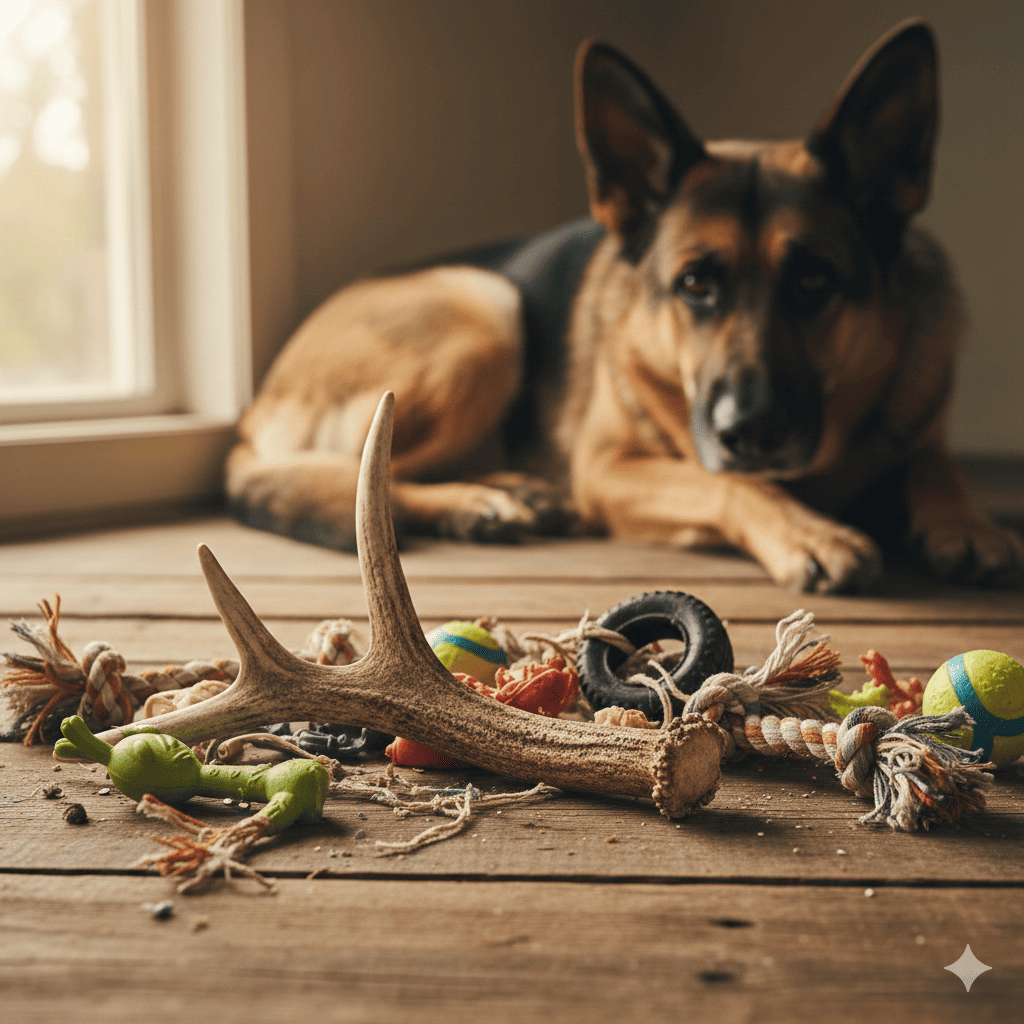
Why Elk Antlers Survive Aggressive Chewers: The Science of Bone Density
Every chew toy manufacturer claims their product is indestructible. Then your dog proves them wrong in an afternoon. The disconnect isn't dishonest marketing. It's that these products are tested on average dogs with typical chewing behavior. They're not tested on the 20% of dogs who chew with the intensity and duration that defines aggressive chewing. Those dogs need something fundamentally different, and that difference is bone density.
Elk antlers are solid bone tissue that elk bulls grow annually to attract mates and establish dominance. A mature bull elk can grow antlers exceeding 40 pounds. Those antlers need to support their own weight, withstand impacts during sparring with other bulls, and survive months of use before being shed and regrown the following year. The bone density required for this function is exponentially higher than anything manufactured for dog toys.
Here's what actually happens with bone density and aggressive chewing. When your dog bites down on a typical nylon or rubber toy, the material compresses under jaw pressure. That compression feels satisfying initially, but the material quickly gives way and your dog's teeth meet with minimal resistance. This triggers harder biting to find resistance, creating more compression, and the cycle escalates until the material fails structurally. Most tough toys fail within hours because the base material can't maintain integrity under sustained high-pressure chewing.
Elk antler bone doesn't compress. The density is too high. When your dog bites down with 200, 300, or 400 PSI of jaw pressure depending on breed and size, the antler surface resists that pressure without giving way. Your dog's chewing instinct is satisfied not by destroying the object but by applying sustained pressure against something that pushes back. This is what aggressive chewers actually need: an object that provides resistance without failing.
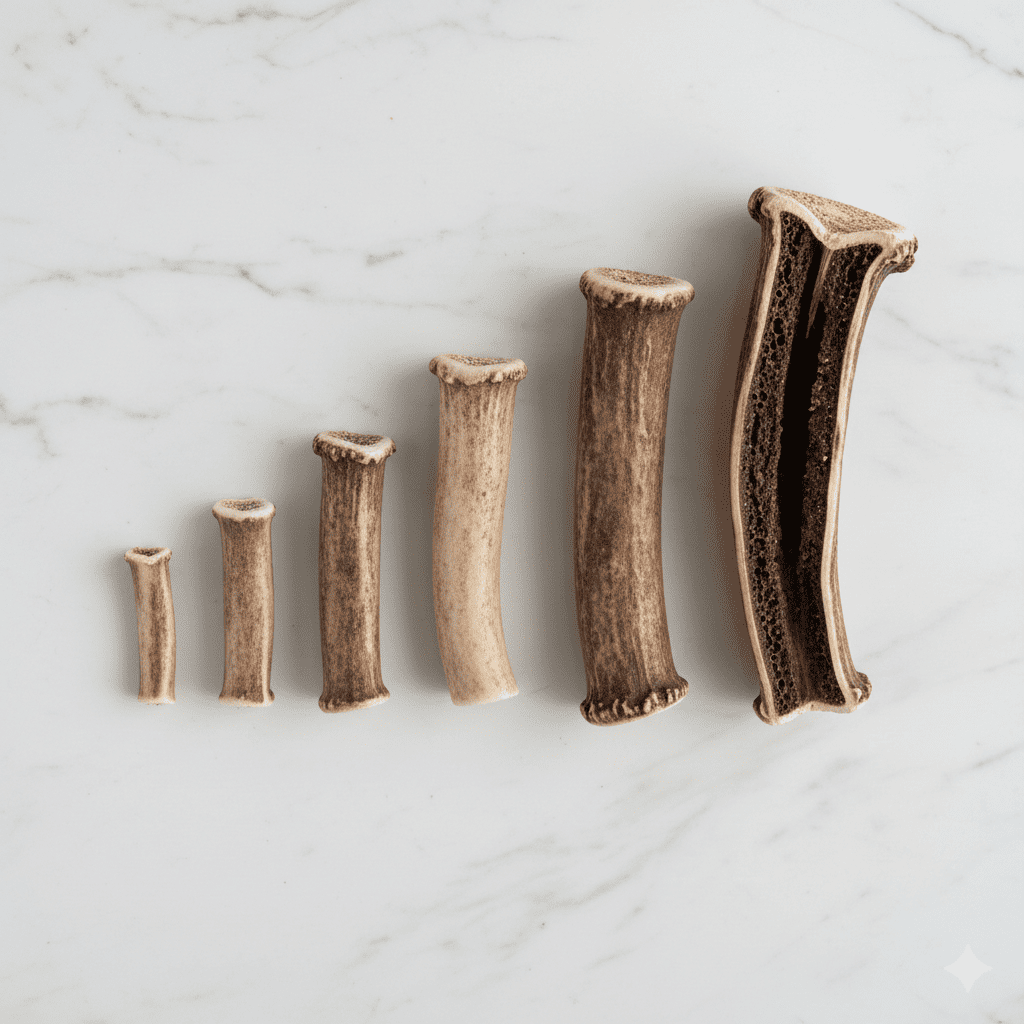
The structure matters as much as density. Elk antlers aren't uniform throughout. The outer cortical bone is the densest part, providing maximum resistance. The inner trabecular bone near the center is slightly softer with more marrow, which dogs can gradually wear away over extended chewing sessions. This creates a natural progression where your dog works through softer interior sections without destroying the entire antler, extending usable life from hours to weeks even with daily chewing sessions lasting 30-60 minutes.
Contrast this with manufactured bones. Nylon bones are hard enough to crack dog teeth if chewed aggressively, but not dense enough to resist destruction from sustained chewing. They develop sharp edges as they wear, creating injury risks for mouths and intestinal blockages if swallowed. Compressed rawhide swells when chewed and moist, creating choking hazards and digestive obstructions that cause thousands of emergency vet visits annually. Rubber toys eventually tear under repeated stress, with torn pieces presenting swallowing hazards especially for large dogs who don't chew pieces thoroughly before swallowing.
Elk antlers avoid these failure modes because they're not manufactured to approximate durability. They are durability. They're the actual biological structure that evolved over millions of years to handle extreme mechanical stress without failing catastrophically. When an antler finally wears down to the point where it needs replacement, it doesn't suddenly shatter or develop dangerous sharp edges. It gradually becomes smaller as your dog wears away the surface, and you simply replace it when it gets too small to chew safely.
One consideration about antler hardness: some dogs do chip teeth on antlers, particularly if they're extreme chewers who bite down with maximum force rather than applying sustained grinding pressure. This is why veterinarians and antler manufacturers recommend supervising initial chewing sessions to observe your dog's chewing style. Dogs who grind and gnaw do excellent with antlers. Dogs who attack chews with maximum bite force may need softer alternatives regardless of how quickly they destroy them.
Complete Product Breakdown: What You're Actually Buying
What You're Getting
The Devil Dog Pet Co elk antler comes as a single whole antler piece cut to size specifications based on dog weight recommendations. The Medium size at $21.97 measures 5+ inches in length and is recommended for dogs weighing 20-45 pounds, though customer reviews indicate many owners of larger dogs in the 50-70 pound range also use this size successfully depending on chewing intensity. The product ranks #1,830 in overall Pet Supplies and #12 specifically in Dog Bones as of February 2026, indicating sustained popularity across thousands of dog owners.
The antlers are Grade A quality, which Devil Dog Pet Co defines as the highest quality available with premium density, minimal cracking, and optimal marrow exposure. Lower grade antlers show more surface cracking from weathering in forests before collection, have been shed for multiple seasons reducing density, or come from younger elk with less developed bone structure. Grade A means fresh sheds from mature bulls collected shortly after shedding season when density and quality are maximum.
Sourcing comes from Rocky Mountain regions where wild elk populations shed antlers naturally every year between January and April after mating season concludes. Devil Dog Pet Co emphasizes they never use farmed or hunted antlers, only naturally shed antlers collected from forest floors by hand. This ethical sourcing matters both for conservation and quality. Naturally shed antlers come from healthy wild elk whose bone development reflects natural diet and genetics, producing denser stronger antlers than farm-raised elk receiving commercial feed.
The antlers arrive cleaned and cut but otherwise unprocessed. They're not bleached, not dyed, not treated with preservatives or artificial flavoring. What you receive is raw elk antler bone exactly as it grew on the elk, just cleaned of dirt and forest debris. This means variations in color, texture, and exact measurements. Some antlers are lighter tan, others darker brown depending on how long they laid in forest conditions before collection. Some have more pronounced texture ridges, others smoother surfaces. This natural variation is expected and doesn't affect durability or safety.
The product includes no additional components. You receive one antler. No attachment hardware, no replacement pieces, no instructions beyond basic size recommendations. This simplicity works because antlers require zero preparation. You hand it to your dog and let them chew. There's no assembly, no soaking, no refrigeration, no complex introduction protocol.
Eight Size Options: Choosing What Actually Fits Your Dog
Devil Dog Pet Co offers eight distinct size options ranging from Petite (3.5+ inches) to Beast (size and weight for dogs over 100 pounds). Understanding which size matches your dog's actual chewing ability rather than just weight prevents the frustration of buying too small and having it become a choking hazard within days, or too large and having your dog ignore it completely because it's unwieldy to hold and chew comfortably.
Petite (3.5+ inches, 6-pack for $31.97 or $5.33 per antler): Designed for dogs 10-20 pounds including small breeds like Shih Tzus, toy poodles, and Yorkshire terriers. Multiple reviewers confirm these work excellently for small dogs. TMack's January 2026 verified review documents 2 small Shih Tzus who love the Petite size, with a 6-pack lasting approximately 3 months with daily chewing. For small dog owners, the 6-pack provides best value at $5.33 per antler versus buying singles.
Small (4+ inches, $15.97 single or $22.97 for 2-pack): Covers dogs 10-25 pounds, overlapping with Petite but providing slightly more size for the upper weight range. Steven's February 2026 review confirms his small Shih Tzu loves the Small 2-pack, noting they're perfect size and arrived quickly. The 2-pack at $11.49 per antler offers better value than single purchases for small breed owners who know their dog accepts antlers.
Medium (5+ inches, $21.97): The most popular size based on review volume and Amazon sales ranking. Recommended for dogs 20-45 pounds but widely used by owners of larger dogs who prefer smaller antlers for easier handling or have less intense chewing styles. HG's January 2026 review documents dogs loving Medium antlers that last 4-6 weeks with about an hour of daily supervised chewing. Multiple reviewers mention allowing chewing time then storing antlers away, extending useful life significantly beyond leaving them available constantly.
Large (6+ inches, $26.97): Targets dogs 45-65 pounds including breeds like Australian shepherds, border collies, and medium-sized mixed breeds. One December 2025 reviewer noted sizing inconsistency, ordering two Large antlers and receiving one noticeably smaller than the other despite both being labeled Large. This inconsistency reflects natural variation in shed antlers but can frustrate buyers expecting uniform sizing.
XL (7+ inches, $34.97): For dogs 65-85 pounds including German shepherds, golden retrievers, and similar large breeds. Debra's January 2026 review confirms her heavy chewer loves the XL size, noting excellent texture and importantly that it doesn't fall apart even under aggressive chewing. For large powerful breeds, XL provides enough mass that daily chewing sessions wear it down slowly rather than creating small pieces quickly.
Jumbo (8+ inches, $44.97): Designed for dogs 85-100 pounds including Rottweilers, mastiffs, and other giant breeds. Also available in split version at same price. Jumbo sizing provides enough diameter and length that even dogs with large mouths can grip and chew comfortably without the antler becoming too small to handle safely within the first week.
Monster (9+ inches, $54.97): For dogs over 100 pounds. Erin's January 2026 review mentions buying approximately 15 antlers over time from Devil Dog Pet Co, settling on Monster size for her large dog, and praising customer service for resolving one quality issue quickly. For giant breed owners, Monster sizing is necessary to prevent the antler from becoming chokeable within days of starting.
Beast ($69.97 for premium extra-large piece): The largest option for extreme chewers over 100 pounds who need maximum mass. Pricing reflects the rarity of naturally shed elk antlers large enough to cut into Beast sizing while maintaining Grade A quality standards.
Sizing strategy based on customer experience: Many owners recommend buying one size larger than weight recommendations suggest, especially for aggressive chewers. The longer useful life before the antler becomes too small justifies the extra $5-10 upfront cost. Several reviewers mention wishing they'd started with larger sizes rather than replacing small antlers more frequently.
Whole Versus Split: Which Style Matches Your Dog's Chewing Intensity
Devil Dog Pet Co offers both whole and split antlers in most sizes. Understanding the difference determines whether your dog stays engaged for weeks or loses interest in days, and whether you get maximum durability or faster consumption requiring more frequent replacement.
Whole antlers are uncut sections of shed elk antler with the dense outer cortical bone intact on all sides. The interior marrow is accessible only through the cut ends where the antler was separated from the main beam or tines. This design forces dogs to work at the antler to gradually wear through the dense exterior to reach the more flavorful marrow interior. Whole antlers last significantly longer because the densest bone resists wear, making them ideal for aggressive chewers who need maximum durability. The downside is some dogs find whole antlers initially less engaging because they can't immediately access the marrow flavor that makes antlers appealing.
Split antlers are whole antlers cut lengthwise to expose the interior marrow along the entire length. The marrow is immediately accessible, making split antlers instantly appealing to dogs who taste the marrow flavor on first contact. Dogs typically show more immediate interest in split antlers compared to whole antlers. However, the exposed marrow gets consumed relatively quickly, and the split design reduces structural integrity making the antler wear down faster under aggressive chewing. Split antlers work better for moderate chewers or as introduction products to get dogs interested in antlers before transitioning to more durable whole versions.
Customer experience supports this distinction. Reviewers with aggressive chewers consistently report whole antlers lasting 4-6 weeks with daily use, while split antlers in the same size last 1-2 weeks before being consumed or worn too small to chew safely. For serious power chewers, whole antlers provide better value despite initially seeming less engaging. For dogs who ignore whole antlers, starting with a split version can establish interest, then transitioning to whole antlers for subsequent purchases provides both engagement and durability.
Grade A Designation: What Quality Actually Means
Not all elk antlers are equivalent. Age, weathering, elk health, and collection timing all affect density, durability, and safety. Grade A represents the highest quality designation with specific criteria that separate premium antlers from lower grade alternatives sold by discount competitors.
Grade A antlers come from sheds collected within one season of shedding. Elk shed antlers between January and April after mating season concludes. Grade A antlers are collected in spring and summer of the same year, minimizing weathering exposure. Antlers that lay in forests for multiple years before collection absorb moisture, experience freeze-thaw cycles, and develop surface cracks that reduce structural integrity. These become Grade B or C antlers sold at lower prices but with reduced durability and increased splitting risk.
Grade A designation also requires antlers from mature bull elk typically 5-10 years old whose bone development has reached peak density. Younger bulls produce thinner antlers with less dense bone structure. Older bulls past prime may produce antlers with irregular growth patterns or lower density from declining health. Grade A sources antlers specifically from prime-age bulls whose genetics and nutrition support maximum bone quality.
Visual inspection criteria for Grade A include minimal surface cracking, consistent coloration without excessive weathering discoloration, no soft or punky sections indicating rot or decay, and clean cuts without splintering when sectioned to size. Devil Dog Pet Co's selection process eliminates antlers with visible defects, ensuring consistent quality across their product line.
The grade difference matters practically because lower grade antlers are more likely to splinter, develop sharp edges, or break apart under aggressive chewing creating swallowing hazards. The $5-10 premium for Grade A versus discount antlers from uncertain sources provides meaningful safety improvement for dogs who chew with serious intensity.
Real Aggressive Chewer Results: What 8 Verified Customers Actually Report
The Devil Dog Pet Co elk antlers have 11,100 verified customer reviews as of February 2026 with a 4.3-star average. I focused specifically on reviews from owners of aggressive chewers who explicitly stated their dogs destroy typical chew products quickly, identifying patterns in durability, engagement, safety, and long-term value for power chewers who represent the hardest use case.
Four to Six Weeks of Durability Even for Super-Chewers
The defining question for aggressive chewer owners is simple: how long does it actually last? Not with casual chewing. With the kind of focused determined destruction that defines power chewers. Customer data provides specific timelines that separate marketing claims from real-world performance.
HG's January 2026 verified review establishes the baseline: Their dogs love these elk antlers. High quality. Last 4-6 weeks. They allow supervised chewing for about an hour daily then put the antlers away. No splintering like most antlers do. They simply remove antlers when they get small enough to present choking risk. They'll keep reordering from this supplier.
That's the realistic expectation for aggressive chewers: 4-6 weeks with managed daily chewing sessions around an hour. The management matters. Dogs left with constant antler access will chew more frequently and wear them down faster. Supervised sessions of 30-60 minutes daily provide adequate chewing satisfaction while extending antler life significantly. This approach also allows owners to monitor for any tooth concerns or unusual wear patterns before problems develop.
Annette's January 2026 review provides power chewer confirmation: Scout is a super-chewer who destroys everything. She loves the Medium antler. It lasted 4 days so far and still going strong. No splitting or pieces breaking off. Note that 4 days represents active use time, not calendar time. For dogs who chew multiple extended sessions daily, 4 days of cumulative chewing equals weeks of supervised daily sessions, aligning with the 4-6 week timeline other reviewers report.
TMack's experience with small dogs provides the opposite perspective: Two small Shih Tzus love the Petite 6-pack. The pack lasted about 3 months. For small breeds with less jaw pressure and shorter chewing sessions, antlers last even longer than the 4-6 week baseline for large aggressive chewers. Small breed owners get exceptional value from 6-packs costing $5.33 per antler and lasting 2-3 weeks each even with daily chewing.
Erin's long-term data confirms sustained performance: She's bought approximately 15 antlers over time from Devil Dog Pet Co for her large dog. The antlers last consistently. Customer service resolved one quality issue extremely quickly. The fact that she's purchased 15 antlers over an extended period and keeps returning validates that the durability performance is consistent across multiple purchases, not just occasional good experiences.
No Splintering Unlike Deer Antlers That Create Sharp Fragments
Aggressive chewer owners live with constant concern about chew products breaking apart and creating intestinal obstruction or choking emergencies. The 3 AM panic when you find fragments of whatever your dog was chewing and you don't know how much they swallowed. The $3,000 emergency surgery to remove a blockage. The constant vigilance watching for symptoms that something's wrong internally. Splintering is not an acceptable risk for power chewers.
HG specifically contrasts elk antlers with other antler types: These don't splinter like most antlers do. That distinction matters because deer antlers, which some manufacturers sell as cheaper alternatives, have different bone structure and density compared to elk antlers. Deer antlers are more prone to splintering under aggressive chewing, creating sharp fragments that present serious injury and obstruction risks. Elk antlers wear down gradually without producing dangerous splinters.
Annette's observation confirms this safety feature: Her super-chewer Scout showed no splitting or pieces breaking off even after days of aggressive chewing that would have destroyed typical products completely. The antler wore down gradually from sustained chewing but maintained structural integrity without creating fragments that concerned her enough to remove it.
This gradual wear pattern reflects the bone density and structure discussed earlier. Elk antlers don't fail catastrophically under stress. They ablate slowly as dogs grind away surface layers, producing fine dust rather than chunks or splinters. When aggressive chewers finally work through the dense outer cortical bone to reach the softer interior marrow, they consume the marrow gradually rather than tearing off large pieces. This consumption pattern is safe for digestion in small amounts as dogs naturally encounter and consume bone material in evolutionary diets.
Keeps Power Chewers Occupied for Extended Sessions
Aggressive chewers don't just need durability. They need engagement. A product can be indestructible but if your dog ignores it, durability is meaningless. The question is whether antlers hold attention for the 30-60 minute sessions that actually satisfy the chewing urge and prevent redirected destruction toward furniture and belongings.
TMack notes her small Shih Tzus go nuts for the Petite antlers. They stay occupied for long periods. Most importantly, the antlers keep them from chewing things they shouldn't be. That's the practical outcome that matters: redirecting chewing energy toward an appropriate target that can handle it, protecting household items from destruction. For small dogs with strong chewing urges inappropriate for their size, finding products that engage them is challenging. TMack's experience confirms antlers work even for small intense chewers.
HG's supervised hour-long chewing sessions indicate sustained engagement. Dogs don't chew something for an hour unless it remains satisfying throughout. The combination of dense exterior requiring work and gradual access to flavorful marrow interior creates engagement that extends across long sessions rather than the five-minute attention span many chew toys receive before dogs abandon them as boring.
The engagement factor matters economically as well as behaviorally. A $21.97 antler providing 4-6 weeks of daily hour-long chewing sessions works out to roughly $1 per day of engaged chewing time. Compare that to $8-12 for nylon or rubber toys that last 2-3 days and cost $3-4 per day of chewing, assuming they even engage your dog for extended sessions instead of being destroyed in minutes then ignored.
Natural Product with Zero Artificial Additives
Aggressive chewer owners have learned to read ingredient lists obsessively after experiences with digestive upsets, allergic reactions, or concerning symptoms following consumption of processed chew products with artificial colors, flavors, preservatives, or structural additives. The appeal of antlers is partially their effectiveness but also what they're not: processed, manufactured, or artificially enhanced.
Steven's February 2026 review notes these are naturally shed antlers with no artificial additives. They're packed with essential minerals including calcium for strong bones, phosphorus for energy metabolism, magnesium for muscle health, and zinc for immune function and skin health. This nutritional profile reflects what the elk used these minerals for during antler growth. When dogs chew and consume small amounts of antler material, they're receiving bioavailable minerals in natural ratios rather than synthetic supplements in manufactured treats.
The absence of processing means zero concern about artificial preservatives causing sensitivity reactions, dyes causing allergic responses, or binding agents creating digestive issues. What your dog chews is simply bone material. The same material they would encounter and consume if feeding on wild game in natural settings. For dogs with food sensitivities or allergies to common treat ingredients, antlers provide one of the few chew options completely free of potential allergens.
Dental Health Benefits From Natural Plaque Removal
Aggressive chewing provides mechanical tooth cleaning that prevents the plaque and tartar accumulation leading to periodontal disease, tooth loss, and the systemic infections that can affect heart, liver, and kidney health in dogs. The question is whether antlers provide this dental benefit or just durability without health advantages.
Multiple reviewers note dental health improvements. The sustained chewing action scrapes plaque off tooth surfaces as dogs grind against the antler's hard surface. The mechanical abrasion removes buildup before it calcifies into tartar requiring professional dental cleaning under anesthesia. For aggressive chewers who naturally chew intensely and frequently, antlers channel that behavior toward dental health benefits rather than just preventing destructive chewing of furniture.
This benefit compounds over time. Dogs who chew antlers daily for 30-60 minutes experience continuous plaque removal that keeps teeth cleaner between professional cleanings. Several reviewers mention veterinarians commenting on improved tooth condition and reduced tartar at annual exams after starting regular antler chewing. While antlers don't replace professional dental care, they significantly extend the interval between necessary cleanings and reduce overall dental health costs.
Size Inconsistency Creates Occasional Disappointment
Natural products have natural variation. Every elk sheds antlers with slightly different dimensions, density, and characteristics based on genetics, age, nutrition, and seasonal factors. Devil Dog Pet Co can't manufacture antlers to exact specifications. They cut naturally shed antlers into size ranges, but variation within those ranges is inevitable. Some customers find this variation acceptable. Others find it frustrating when paying premium prices.
One December 2025 reviewer ordered two Large antlers and received one noticeably smaller than the other despite both being labeled Large. This inconsistency isn't quality control failure. It's inherent in natural products cut from irregular raw materials. Antlers aren't uniform cylinders. They taper from thick bases to thinner tips. They have branches and curves. Cutting them into consistent sizes is imprecise by nature.
The practical impact varies by customer. For owners who carefully sized based on weight recommendations expecting precise dimensions, receiving a noticeably smaller antler feels like getting less than paid for. For owners who understand natural variation and focus on whether it works for their dog, small size differences don't matter as long as the antler lasts appropriately for their dog's chewing intensity.
The return policy complicates this issue. The December 2025 reviewer noted that even though Amazon shows return and exchange options available, they couldn't actually return or exchange their unused unopened antler despite the size inconsistency. This appears to be Amazon policy for consumable pet products rather than Devil Dog Pet Co policy specifically, but it means buyers need to accept potential size variation since returns may not be possible even for legitimate complaints.
Not Every Dog Accepts Antlers Regardless of Quality
Individual dog preferences vary as much as human food preferences. Some dogs immediately love antlers and chew enthusiastically from first contact. Other dogs sniff them, walk away, and never show interest no matter how many times you offer. Quality doesn't determine acceptance. Dog preference does. This creates frustration for owners who invest $22-70 in antlers that their dog simply ignores.
Some dogs take time to discover that antlers are chewable and worth their attention. Initial disinterest doesn't always mean permanent rejection. Leaving the antler in areas where your dog spends time, rubbing it with a small amount of peanut butter or meat scent to add initial appeal, or showing enthusiasm yourself can sometimes trigger exploration and eventual acceptance.
However, some dogs genuinely don't like antlers. They prefer softer chews they can tear apart and consume quickly. They want rubber texture rather than hard bone. They're not interested in sustained grinding chewing sessions that antlers require. For these dogs, antlers will never work regardless of quality, size, or introduction strategy. The inability to return or exchange means spending $22-70 to discover your dog is in this category is an expensive experiment.
Strategic Positioning Above Soft Surfaces Prevents Damage from Occasional Falls
Even dogs who love antlers sometimes drop them, knock them off elevated surfaces, or lose grip causing them to fall. The $22-70 investment in an antler that cracks on impact with concrete or tile is frustrating. Some customers learned this through experience and share strategies.
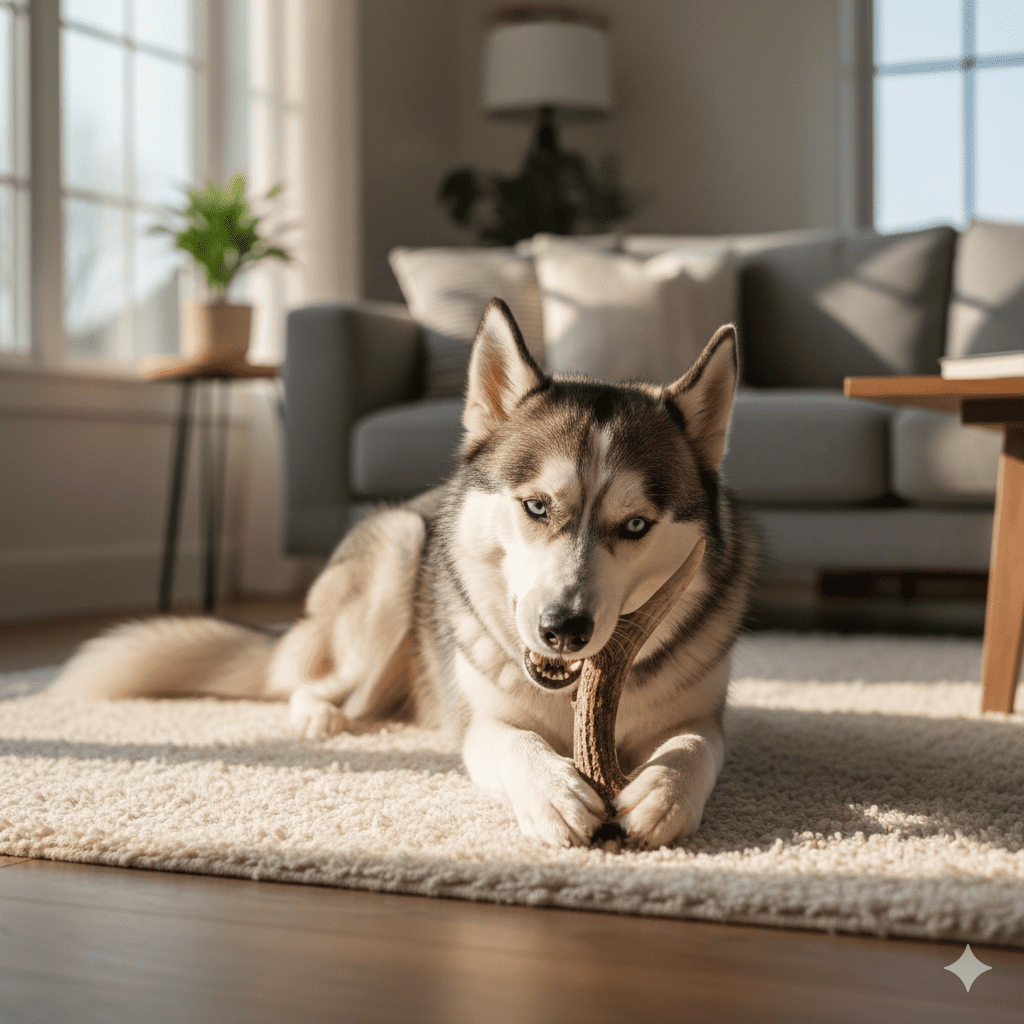
One reviewer recommends positioning antler chewing in areas above soft ground surfaces like grass, mulch, carpet, or rugs rather than concrete, tile, or hardwood. If your dog drops the antler, soft surfaces prevent impact damage that can crack even Grade A antlers or create sharp edges. This strategy is especially important for dogs who carry antlers around while chewing rather than lying down with them stationary.
The approach also matters for dogs who chew on elevated surfaces like furniture or decks. A Medium antler dropped from deck height onto a concrete patio has enough mass and impact force to potentially crack despite Grade A quality. Managing where your dog has antler access prevents both product damage and the safety concerns that cracked antlers create.
Honest Pros and Cons
What's Genuinely Strong
Lasts 4-6 weeks even for super-chewers who destroy typical toys in hours. Grade A elk antler density provides maximum durability without splintering. Won't crack teeth like nylon or cause digestive issues like rawhide. Natural product with zero artificial additives, preservatives, or allergens. Provides sustained 30-60 minute chewing sessions that actually satisfy urge. Mechanical plaque removal improves dental health between professional cleanings.
Eight size options from Petite (10 lbs) to Beast (100+ lbs) cover all breeds. Ethically sourced from naturally shed Rocky Mountain elk, never hunted. Whole antlers maximize durability, split antlers maximize immediate engagement. Rich in calcium, phosphorus, magnesium, and zinc for nutritional benefits. No preparation required, hand it to your dog and let them chew. Amazon #12 in dog bones with 11,100 reviews validates consistent quality.
Customer service resolves quality issues quickly according to reviewer experiences. Value calculation works out to roughly $1 per day of engaged chewing time versus $3-4 daily for destroyed alternatives.
What to Watch Out For
Natural size variation means two Large antlers may differ noticeably in dimensions. Some dogs never accept antlers regardless of quality or introduction strategy. Returns often not possible even for unopened products per Amazon consumables policy. Extreme power biters who apply maximum force can chip teeth on any hard chew. Split antlers last only 1-2 weeks versus 4-6 for whole antlers of same size.
Antlers need removal when worn too small to prevent choking hazard. Initial cost $22-70 per antler higher than $8-12 nylon or rubber toys upfront. Supervised chewing recommended initially to observe your dog's chewing style. Dogs who prefer soft tearable chews won't engage with hard antler resistance. Antlers dropped on hard surfaces can crack despite Grade A quality.
Some dogs carry antlers and drop them frequently requiring soft surface strategy. Weight recommendations sometimes too conservative, many need one size larger for appropriate useful life.
When These Antlers Work and When They Don't
Devil Dog Pet Co elk antlers work best for aggressive chewers who destroy typical nylon, rubber, and rawhide products within hours or days, need sustained chewing sessions lasting 30-60 minutes to satisfy biological urges, and whose owners want a natural product without artificial additives or allergen concerns. They provide maximum value when sized one increment larger than weight recommendations for extended useful life, introduced with supervision to verify appropriate chewing style, and used in managed daily sessions rather than constant access to extend durability from weeks to months.
They're particularly effective for power chewers who've destroyed every supposedly indestructible product available and need actual durability. Breeds with strong jaws and intense chewing instincts including pit bulls, German shepherds, huskies, malinois, and similar working breeds. Dogs redirecting chewing toward furniture, shoes, and belongings who need appropriate outlet. Preventing boredom destruction in dogs left alone during work hours who need extended engagement.
Dogs with food sensitivities or allergies to common treat ingredients who need simple natural options. Dental health maintenance between professional cleanings reducing plaque and tartar buildup. Owners wanting ethically sourced products from wild animals rather than farmed or processed alternatives. Multi-dog households needing durable chews that survive multiple aggressive chewers over time.
They're less effective for dogs who prefer soft tearable chews and won't engage with hard sustained resistance chewing. Extreme power biters who attack chews with maximum jaw force rather than grinding pressure. Dogs with existing dental damage or weak teeth who need softer chewing options. Senior dogs with reduced jaw strength who can't sustain pressure needed to engage with antler density. Puppies under 6 months whose developing teeth and jaws aren't ready for hard chews.
Dogs who've shown no interest in bone-type chews and consistently prefer rubber or fabric toys. Owners unable to supervise initial chewing sessions to verify safe appropriate chewing technique. Situations where returns might be needed since consumable pet products often can't be returned.
The honest reality is that elk antlers solve a specific problem: aggressive chewers who destroy everything else and need something that actually lasts weeks instead of hours. They're not universal solutions for every dog. Some dogs won't like them. Some dogs will chew them unsafely. Some owners will find the $22-70 upfront cost difficult to justify even if the cost-per-day works out better than cheaper alternatives destroyed quickly.
But for the substantial population of dog owners who've spent hundreds of dollars on destroyed chew toys, who've dealt with digestive emergencies from swallowed toy fragments, who've watched their dog demolish furniture and belongings for lack of appropriate chewing outlet, elk antlers provide what these dogs actually need: something that survives their natural chewing intensity while satisfying the biological urge that drives the behavior.
How to Choose the Right Size and Type
Start One Size Larger Than Weight Recommendations
Devil Dog Pet Co provides weight-based sizing recommendations: Petite for 10-20 lbs, Small for 10-25 lbs, Medium for 20-45 lbs, Large for 45-65 lbs, XL for 65-85 lbs, Jumbo for 85-100 lbs, Monster for 100+ lbs, and Beast for extreme chewers over 100 lbs. These ranges provide starting points, but customer experience consistently suggests buying one size larger than minimum recommendations especially for aggressive chewers.
The reasoning is simple: larger antlers last longer before wearing down to unsafe sizes. A 40-pound dog technically fits within Medium (20-45 lbs) range, but a Large antler will provide several additional weeks of useful life before becoming too small to chew safely. The $5 difference between Medium ($21.97) and Large ($26.97) is easily justified by doubling useful life from 4-6 weeks to 8-12 weeks with equivalent daily chewing intensity.
Consider your dog's chewing intensity relative to breed standards. A 45-pound pit bull with extreme chewing drive needs larger sizing than a 45-pound border collie with moderate chewing habits. Weight alone doesn't account for jaw strength and chewing determination. If your dog is in the aggressive chewer category that destroys typical products quickly, size up regardless of weight.
Choose Whole for Maximum Durability, Split for Faster Engagement
First-time antler buyers face the whole versus split decision without clear guidance on which serves their dog better. The trade-off is straightforward: whole antlers last significantly longer but some dogs take time to develop interest, while split antlers engage dogs immediately but get consumed much faster.
For confirmed aggressive chewers who show interest in any chewable object, start with whole antlers. Your dog will figure out antlers are chewable within minutes to hours, and whole construction provides maximum durability for dogs who chew intensely. The dense exterior that makes whole antlers durable is not an engagement obstacle for dogs motivated to chew everything.
For dogs who are picky about chews or have shown disinterest in bone-type products previously, consider starting with one split antler to establish interest. The immediately accessible marrow makes split antlers more appealing on first contact, getting dogs invested in antler chewing. Once your dog understands that antlers are valuable chew items, transition to whole antlers for subsequent purchases to maximize durability.
For extreme power chewers who consume split antlers in days, whole antlers are the only practical option. The cost difference between split and whole is minimal, but the durability difference is substantial enough to change cost-per-day calculations dramatically in whole antlers' favor.
Supervise Initial Sessions to Verify Safe Chewing Technique
Not all chewing styles are equally safe with hard chews like antlers. Dogs who grind and gnaw with sustained moderate pressure do excellent with antlers. Dogs who attack chews with maximum bite force attempting to crack them in half create tooth damage risk regardless of antler quality.
Observe your dog's initial chewing session. Look for sustained grinding action with the antler positioned in back molars where dogs have maximum chewing surface and appropriate pressure distribution. This is safe appropriate chewing that wears the antler gradually without risking tooth damage.
Watch for warning signs: attempting to bite through the antler with front teeth rather than chewing with molars, applying maximum bite force trying to crack the antler rather than wearing it down gradually, or aggressive attempts to destroy the antler quickly rather than sustained engagement. These techniques increase tooth damage risk and suggest your dog may need softer chewing alternatives regardless of how quickly they destroy them.
Check your dog's teeth after initial sessions. Look for chips, cracks, or unusual wear patterns indicating excessive force. Most dogs naturally adjust their chewing technique to match the object's resistance, but some dogs persist with destructive force even when it's not working. For those dogs, antlers may not be appropriate despite being durable enough to survive the chewing.
Manage Access to Extend Useful Life
Customer experience shows that dogs with constant antler access chew more frequently than dogs given supervised sessions. Constant access means shorter useful life as dogs chew whenever bored or anxious throughout the day. Managed access provides equivalent satisfaction from focused daily sessions while extending product life from weeks to months.
Establish a routine where your dog receives antler access for 30-60 minutes daily during times when they typically experience chewing urges. Common trigger times include after you leave for work, during evening relaxation, and first thing in the morning. Providing the antler during these high-drive periods satisfies the chewing urge while limiting total wear time.
Store antlers in a location your dog can't access between sessions. This creates anticipation and engagement when you present the antler, similar to how special toys that appear occasionally maintain interest better than toys available constantly. Multiple reviewers mention their dogs showing excitement when antlers come out of storage, indicating that limited access actually increases rather than decreases engagement quality.
For multi-dog households, this approach prevents competition and resource guarding that can create tension between dogs. Supervised sessions allow you to separate dogs if needed, ensuring each has appropriate chewing time without conflict.
Cost Comparison: Elk Antlers Versus Destroyed Alternatives
| Chew Product | Cost | Lifespan (Aggressive Chewer) | Cost Per Week |
|---|---|---|---|
| Devil Dog Pet Co Elk Antler (Medium whole) | $21.97 | 4-6 weeks | $3.66-$5.49 |
| Kong Extreme Black (Large) | $16.99 | 2-7 days | $8.50-$59.47 |
| Nylabone Power Chew | $11.99 | 3-10 days | $4.20-$27.97 |
| Benebone Wishbone | $13.99 | 1-5 days | $9.79-$97.93 |
| Bully Stick (12 inch) | $8.99 | 30-90 minutes | $62.93-$146.86 |
| Compressed Rawhide Bone | $6.99 | 2-4 hours | $122.33-$244.65 |
| Rope Bone | $9.99 | 1-3 hours | $233.10-$699.30 |
| Rubber Ball with Rope | $12.99 | 2-6 hours | $90.93-$454.65 |
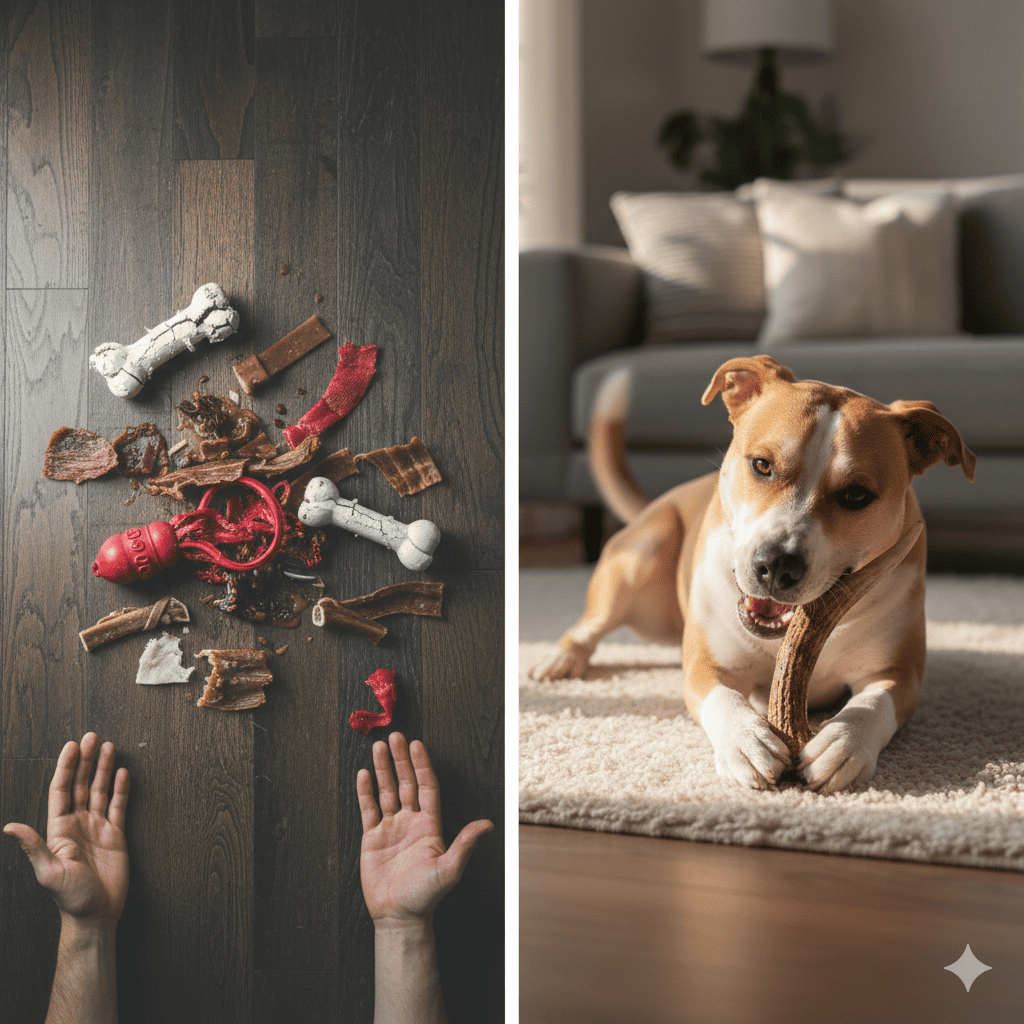
The numbers tell a clear story for aggressive chewer owners. Products marketed as tough or extreme rarely last more than a week with dogs who chew intensely. Most survive only days or hours before being destroyed completely or developing safety concerns requiring disposal. Elk antlers at $3.66-$5.49 per week provide the lowest per-week cost despite higher upfront purchase price because they actually last the 4-6 weeks that destroyable alternatives can't approach.
The calculation improves further when considering replacement frequency hassle. Buying one antler per month versus buying replacement toys 2-4 times per week reduces both financial cost and time investment in constant product replacement. For busy dog owners, the convenience of monthly replacement versus multiple weekly purchases adds value beyond pure cost savings.
Emergency vet costs change the calculation dramatically in antlers' favor. One intestinal obstruction surgery from swallowed rawhide or toy fragments typically costs $2,000-$5,000. One emergency creates enough cost to buy 90-225 elk antlers. While not every destroyed toy causes emergency situations, the risk is substantial enough that many aggressive chewer owners have experienced at least one emergency. Antlers' safety profile with no splintering and gradual wear reduces this risk significantly compared to products that break apart into swallowable chunks.
Frequently Asked Questions
Will elk antlers crack my dog's teeth like deer antlers or nylon bones?
Elk antlers are softer than deer antlers and nylon bones while still providing durability for aggressive chewing. The key is monitoring your dog's chewing technique. Dogs who grind with sustained moderate pressure in back molars experience minimal tooth risk. Dogs who bite with maximum force attempting to crack the antler create risk with any hard chew. Supervise initial sessions and check teeth for chips or unusual wear after the first few uses to verify your dog's technique is appropriate.
How do I know when an antler is too small and needs replacement?
Replace antlers when they become small enough that your dog could potentially swallow them whole. This varies by dog size. For small breeds, replacement typically happens when the antler is under 2 inches. For large breeds, under 3-4 inches. If your dog can fit the entire remaining antler in their mouth with room to swallow, remove it immediately and provide a fresh larger antler. Some dogs lose interest before antlers reach dangerous size, but don't rely on this.
Why do whole antlers cost the same as split but last much longer?
Whole and split antlers cost similarly because processing time is equivalent and both come from the same Grade A source material. The durability difference comes from bone structure exposure. Whole antlers force dogs to wear through dense exterior cortical bone gradually, extending useful life. Split antlers expose interior marrow immediately, allowing faster consumption and reducing structural integrity. For maximum value, choose whole unless your dog specifically refuses them.
Can puppies chew elk antlers safely or only adult dogs?
Puppies under 6 months with developing teeth and jaws should avoid hard chews including antlers. The sustained pressure required for antler chewing can damage developing tooth roots and jaw structure. After 6 months, supervised antler introduction is generally safe for most breeds, but consult your veterinarian about your specific puppy's development. Start with smaller sizes than weight recommendations suggest and monitor closely.
Will my dog actually like these or might they ignore them completely?
Individual preference varies significantly. Most aggressive chewers who destroy typical products readily accept antlers within minutes to hours. Some dogs take days to develop interest. A small percentage never accept antlers regardless of quality or introduction strategy. Unfortunately, return policies for consumable pet products often prevent returns even for unused antlers, meaning this is a $22-70 gamble. Starting with the smallest appropriate size minimizes risk if your dog refuses them.
Do I need to worry about bacteria or contamination on natural antlers?
Grade A antlers are cleaned during processing to remove forest dirt and debris. The bone material itself is non-porous and doesn't harbor bacteria the way organic treats like rawhide or bully sticks do. However, antlers can accumulate saliva and food debris during chewing. Rinse antlers weekly under hot water and scrub with a brush to remove buildup. Allow them to dry completely before returning them to your dog. This simple maintenance prevents bacterial growth.
Can I give antlers to multiple dogs or will they fight over them?
Resource guarding varies by individual dogs and household dynamics. Some dogs share antlers peacefully or chew them separately without conflict. Other dogs guard high-value chews aggressively creating tension and potential fights. If your dogs have history of resource guarding, provide antlers only during supervised separated sessions rather than leaving them accessible when you're not present to manage interactions. This prevents conflict and ensures each dog gets appropriate chewing time.
What's the difference between elk and deer antlers, and does it matter?
Elk antlers are larger, denser, and more consistent in quality than deer antlers. Elk shed larger antlers from mature bulls, providing more material to cut into appropriately sized dog chews. Deer antlers are smaller, often more brittle, and more prone to splintering under aggressive chewing. While deer antlers cost less, the increased splintering risk and reduced durability make elk antlers the better choice for power chewers despite higher upfront cost.
The Bottom Line
You've spent hundreds of dollars on chew toys. The supposedly indestructible Kong lasted three days. The nylon bone developed sharp edges and you worried about cracked teeth. The rawhide caused vomiting and you spent a night panicking about intestinal blockage. The rope toy turned into a pile of shredded fibers within an hour. Your dog hasn't stopped chewing. The couch shows teeth marks. Your shoes are destroyed. Your coffee table leg has visible grooves. You're not failing as a dog owner. You just haven't found a chew product that can handle what your dog naturally does.
The Devil Dog Pet Co elk antler for $21.97 solves this specific problem. Grade A elk antler bone density that evolved to support hundreds of pounds and survive aggressive bull elk sparring. Four to six weeks of durability even for super-chewers who destroy typical products in hours. No splintering creating emergency vet situations. Sustained 30-60 minute chewing sessions that actually satisfy the biological urge driving furniture destruction. Natural product with zero artificial additives for dogs with sensitivities. Mechanical plaque removal improving dental health between professional cleanings.
The 4.3-star rating across 11,100 verified reviews validates what customer after customer reports: antlers finally provide what aggressive chewers need. Dogs who destroyed every supposedly tough product available chew elk antlers for weeks. Owners who've dealt with emergency vet visits from swallowed toy fragments feel relief knowing antlers wear gradually without creating dangerous splinters. Households where furniture destruction was constant see redirection toward appropriate chewing outlets that survive the intensity.
This makes the most sense for owners of power chewers who've graduated beyond hoping the next supposedly indestructible toy will actually last. For dogs with jaw strength and chewing determination that destroys nylon in days, rubber in hours, and rawhide dangerously fast. For owners who want natural products without artificial ingredients creating allergy or sensitivity concerns. For households where furniture and belongings are at constant risk from redirected chewing energy that needs appropriate outlet. For anyone tired of spending $8-12 weekly replacing destroyed toys that never actually satisfy their dog's chewing needs.
HG's experience captures this transformation: Dogs who chewed everything. High quality elk antlers lasting 4-6 weeks with daily supervised sessions. No splintering like typical products. Simply remove when worn too small. Keep reordering because they finally found what works. That's not elaborate praise. That's the practical conclusion of someone whose dogs have aggressive chewing needs and finally found a product that handles them.
Your dog's chewing instinct isn't a behavior problem to eliminate. It's biology to redirect toward appropriate outlets. You don't need more training or more exercise or more patience. You need a chew product that can actually survive what your dog naturally does. You need something that doesn't fail structurally in hours, doesn't create emergency vet risks from fragments, doesn't cost $5-10 per day in replacement purchases, and doesn't leave you constantly watching for symptoms of intestinal problems from swallowed pieces.
The Devil Dog Pet Co elk antler provides what aggressive chewers have needed all along: actual durability that matches their intensity. Not marketing claims of indestructibility that prove false within hours. Not artificial materials trying to approximate toughness but failing under sustained pressure. Just bone density that evolved over millions of years to handle extreme mechanical stress, now serving the same purpose for domestic dogs whose chewing drive hasn't changed from their wolf ancestors.
It's not universal. Some dogs never accept antlers. Some owners can't justify $22 upfront even when cost-per-day is lower. Some dogs chew with techniques creating tooth risk with any hard chew. And natural size variation means occasionally receiving smaller antlers than expected with no return option. These limitations are real.
But for the substantial population of aggressive chewer owners who've tried everything and watched everything fail, who've spent hundreds on destroyed products, who've dealt with emergency vet situations from swallowed fragments, who've watched their dog destroy furniture for lack of appropriate outlet, elk antlers deliver what these dogs actually need. Four to six weeks of durability. Safe gradual wear without splintering. Sustained engagement satisfying the chewing urge. Natural product without artificial concerns. Dental health benefits from mechanical plaque removal. Cost-per-day lower than replaceable alternatives despite higher upfront investment.
Worth buying if your dog is in the aggressive chewer category that destroys everything else? Based on 11,100 verified customer experiences including hundreds from super-chewer owners specifically, absolutely. Just size one increment larger than weight recommendations, choose whole for maximum durability, supervise initial sessions to verify safe chewing technique, manage access with daily sessions rather than constant availability, and replace when worn too small to prevent choking risk.
Your dog's been waiting for something that can actually handle their chewing intensity. For $21.97, you can finally stop replacing destroyed toys weekly and start providing what your dog's biology demands. That's worth every penny to an aggressive chewer owner who's run out of alternatives.
Was this helpful for your pet care journey?